
Hiring managers are often asked to make quick decisions with incomplete information.
Resumes can be polished, interviews can be subjective, and experience alone does not always predict job success.
That is why Scheig Solutions’ SelectRight™ assessment and My Account Portal (MAP) are designed to help managers prioritize candidates using objective, job-specific data.
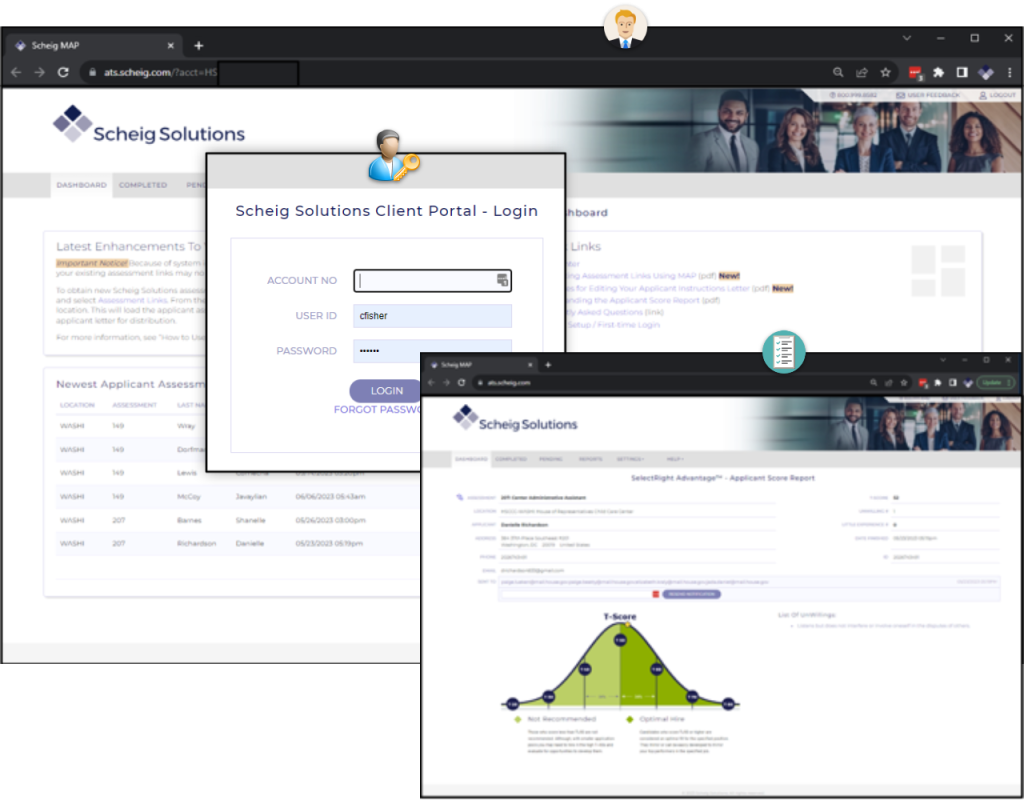
At the center of that process is the T-Score. In MAP, the T-Score gives hiring teams a clear and standardized way to compare applicants who have completed the SelectRight™ assessment. Instead of using percentages, which can be misleading, Scheig Solutions uses a T-distribution so applicants are measured on the same scale. A T-Score of 50 represents the average, while scores above 50 indicate stronger alignment with the behaviors demonstrated by superior performers in that specific job.
This matters because SelectRight™ is not designed to measure personality in the abstract. It is designed to measure the person for the job. Scheig assessments are developed through detailed job analysis with top performers, identifying the behaviors that contribute most directly to successful performance. The result is a Job Success Profile™ that becomes the standard against which applicants are measured.
MAP makes that information easy to use. In the Completed Assessments section, managers can sort applicants by T-Score, bringing stronger-fit candidates to the top of the list. This simple habit helps teams build interview lists faster, reduce time spent on lower-fit applicants, and apply the same decision-making process across managers, roles, and locations.
The T-Score should not replace good judgment or the interview process. Instead, it should help managers decide where to begin. Once top candidates are identified, the Applicant Score Report provides additional insight, including experience indicators and any unwilling responses. These details help interviewers ask better questions, clarify concerns, and confirm whether the candidate’s behavioral fit matches the job’s needs.
For best results, review completed assessments daily, sort by T-Score, open the ASRs for your strongest candidates, and use that information to guide structured interviews. With MAP, the T-Score becomes more than a number. It becomes a practical tool for faster, fairer, and more confident hiring decisions.