

Executive summary
Scheig’s methodology remains trustworthy because it measures candidates against the real behaviors of known superior performers, not against abstract personality constructs. Through detailed job analysis, expert-panel input, proprietary statistical prioritization, standardized T-score reporting, and legally defensible validation practices, the system is designed to improve hiring accuracy, reduce turnover, strengthen productivity, and support fair decision-making.
For long-time clients, the question is often not whether pre-employment assessments can help. It is whether the assessment they have relied on for years remains as accurate, reliable, and defensible as needed. Scheig’s answer is yes, because the system was built on a job-specific scientific method rather than a generic testing trend.
Across more than three decades of work, Scheig has developed behaviorally based selection and development systems used across industries and global markets. Scheig SelectRight assessments have been administered to millions of applicants. The core promise has stayed consistent: measure the person for the job, not in the abstract. That principle is why Scheig remains distinctive and why long-standing clients continue to see it as a dependable part of a sound hiring process.
Why traditional hiring still leaves too much to chance
The need for that kind of dependability is greater than ever. Traditional hiring methods still dominate in many organizations, yet Scheig repeatedly highlights their limits. Resumes and experience summaries can be embellished. Interviews provide useful face-to-face interaction, but they are often subjective and, according to Scheig’s training materials, are only about 50/50 in predicting performance.
Skills and knowledge testing have value, but it is usually used only as a minimum qualification rather than a full predictor of success. That matters because Scheig’s methodology is built around a simple but powerful insight: even in technical jobs, only about 30 percent of performance is technical. The remaining 70 percent is made up of human-factor behaviors such as reliability, judgment, teamwork, communication, follow-through, adaptability, and attention to detail. When organizations hire for the visible 30 percent and ignore the rest, they leave performance to chance.
That is also why the quality-of-hire problem is so costly. Scheig frames turnover, poor fit, hiring speed, bias, and productivity drag as persistent business problems, not merely HR headaches. Outstanding workers are described as two to three times more productive than barely acceptable workers. In other words, the gap between an average hire and the right hire is not marginal. It affects output, training burden, safety exposure, morale, and the cost of replacing people who should never have been hired in the first place. Scheig positions hiring predictability as a competitive advantage because predictability lowers wasted interviews, reduces downstream rework, and improves workforce stability.
How Scheig defines job success before hiring begins
Scheig’s methodology addresses that problem at the source: by defining success before hiring begins. Every Scheig assessment starts with an extremely detailed job analysis, conducted with recognized superior performers and subject-matter experts for a specific role. This process typically identifies 300 to 500 job behaviors that describe how the work is actually done. Those behaviors can include knowledge, skills, abilities, willingness, interests, and personal characteristics, but they are framed as job-relevant actions rather than broad personality labels. Once that large behavior inventory is built, expert panels and proprietary statistical methods are used to determine which behaviors carry the greatest value for performance. The result is the Job Success Profile – a prioritized standard built from how top performers actually do the job. In practical terms, Scheig does not guess what excellence looks like. It studies it, defines it, and measures against it.
This is what gives the methodology its validity. Many assessments on the market measure personality constructs, general aptitude, or abstract traits, then ask employers to make a logical leap from a label to job performance. Scheig materials challenge that model directly. They ask a common-sense question: why measure the person in the abstract when you can measure the person for the job? A high-performing introvert and a high-performing extrovert may differ in personality, but both still exhibit the concrete behaviors that drive results. By anchoring assessment content to the actual behaviors of high performers, Scheig creates direct content validity – a close match between what is measured and what the role requires. Its internal validity materials further emphasize that this content is not only expert-informed but also statistically prioritized, strengthening the connection between the assessment and real-world performance outcomes.
How SelectRight is engineered for accuracy
SelectRight’s design also helps explain why clients experience it as accurate and trustworthy in day-to-day use. The assessment generally takes 20 to 30 minutes and may include up to three sections. The first section, Interest and Willingness, is not scored. Instead, it serves as a realistic preview of the role and gives applicants the chance to indicate where they lack experience or are unwilling to meet a condition of employment. This makes the process more transparent for both the employer and the applicant. The second section, Self-Rating, is the core scored section. It pairs high-performance behaviors with lower-performance alternatives and controls for social desirability, reducing the likelihood that applicants simply pick the statement that sounds best. In some versions, a third section, Critical Incidents, presents job-specific scenarios sourced from expert panels so applicants can demonstrate how they would respond to real on-the-job situations. Together, these sections create a fuller, more job-relevant picture than a generic personality inventory or a resume screen.
Why the T-score matters
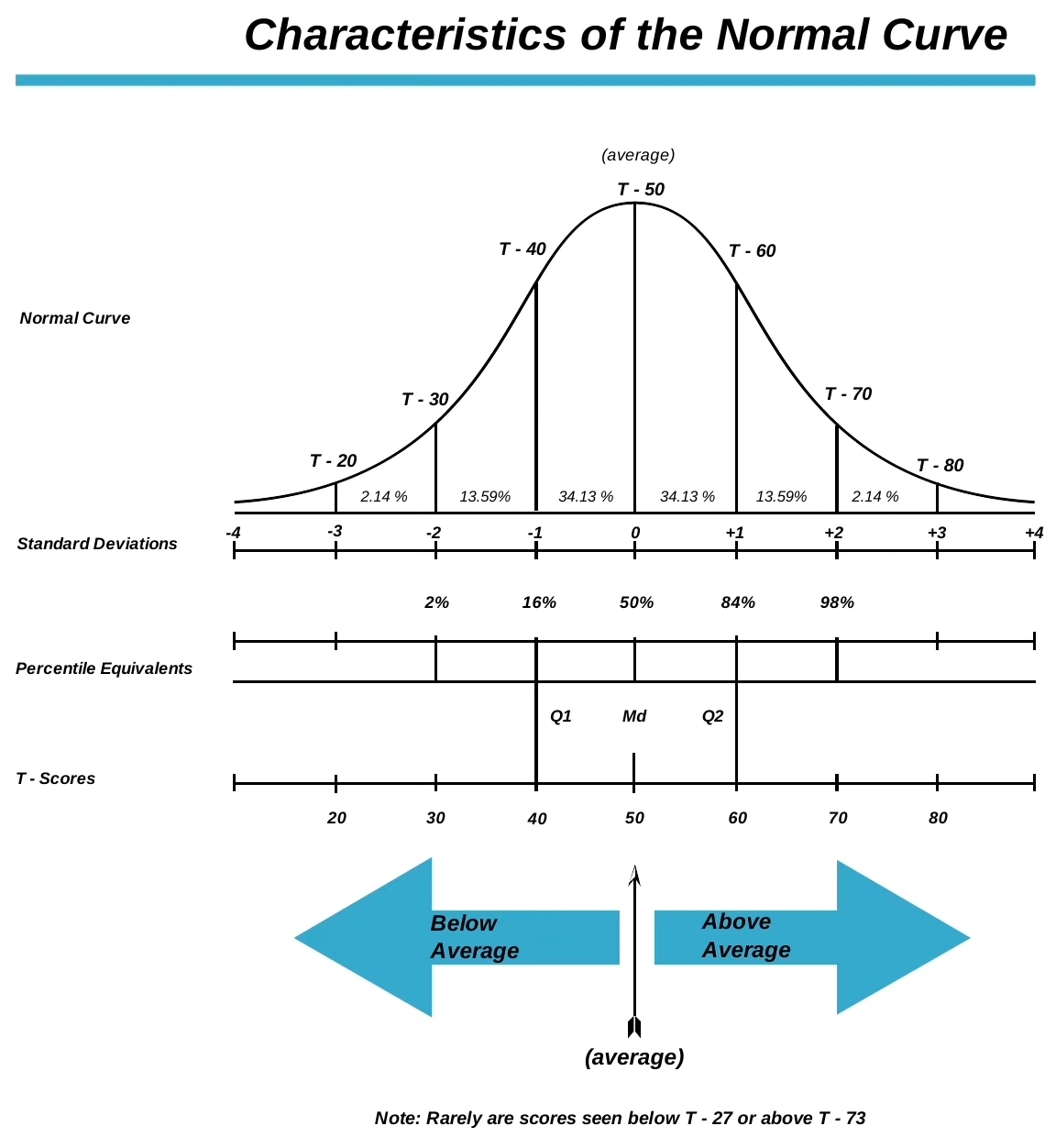
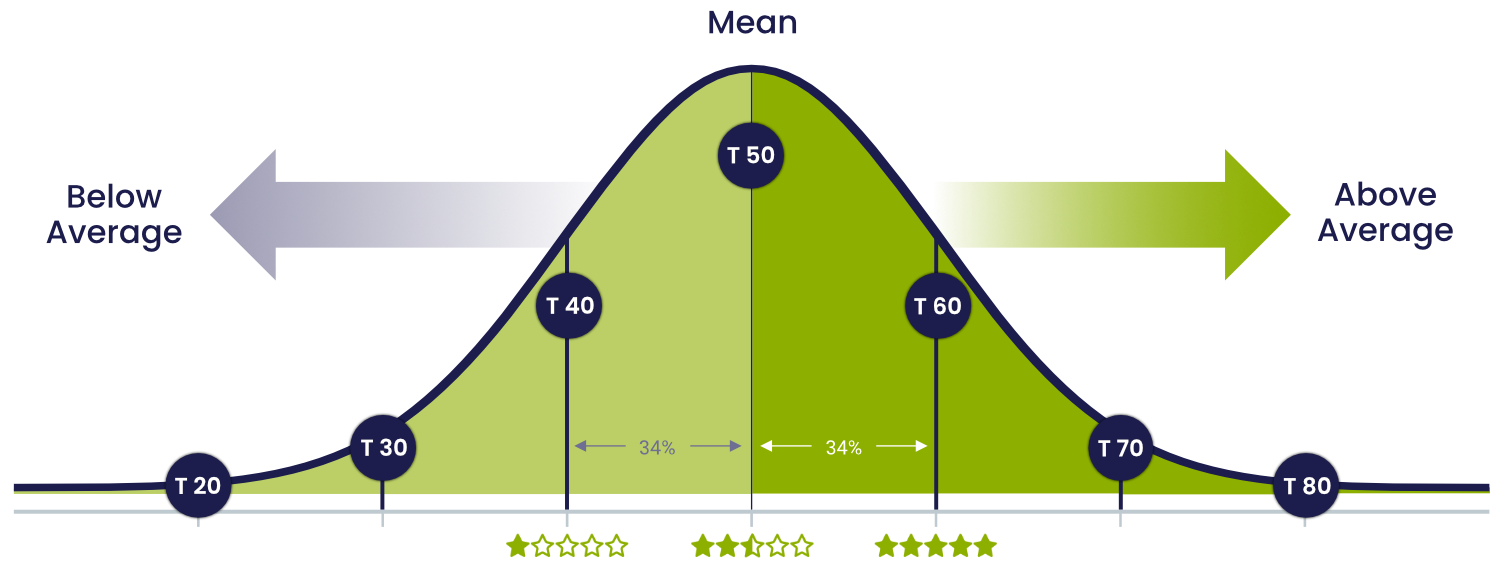 The scoring methodology adds another layer of clarity. Scheig uses a standardized T-score rather than raw percentages. T=50 is the average; each standard deviation is ten points, and roughly 68 percent of applicants fall between T=40 and T=60. Because the score is standardized, hiring teams can compare all assessed applicants on the same scale. Scheig materials explain that T=50 is both the mean and the median, and that a T-score above 50 indicates stronger alignment with the behavioral profile of known superior performers. A score such as T=55 is therefore not mediocre – it is a strong score, half a standard deviation above average. The Applicant Score Report makes this easy to use by combining the T-score with reported experience and any unwilling responses, allowing managers to move quickly from data to decision.
Validity, reliability, and legal defensibility
For a long-time client, the most important reassurance may be that Scheig’s methodology is not only intuitive but also built to withstand scrutiny. Scheig selection and hiring tools have and maintain strong content and criterion-related validity, high test-retest reliability, and an iterative process of item development, piloting, analysis, and refinement. The legal foundation is equally important. All Scheig tools comply with the Uniform Guidelines on Employee Selection Procedures and align with EEOC and OFCCP standards. They also emphasize objective, job-related criteria, consistent scoring, and monitoring for adverse impact. That matters because a useful assessment must do more than predict performance. It must help organizations make fair, explainable, and legally defensible decisions.
What clients value in practice
The business results achieved with Scheig’s SelectRight™ tools are the practical expression of that science. Clients are encouraged to use the assessment early in the process, before investing time in interviews and later-stage screening. The expected payoff is a better interview-to-selection ratio, lower turnover, quicker onboarding, stronger productivity, and better safety outcomes. Scheig cites outcomes such as substantial reductions in turnover, fewer workers’ compensation claims, shorter training periods, improved customer service, and productivity gains of up to 300 percent in some applications. The AmeriGas case study underscores why this matters in high-stakes environments: when employees handle hazardous materials, selecting safety-conscious people and improving retention is not just an efficiency issue – it is a risk-management issue. Other corroborative materials include client testimonials describing reduced turnover, reduced training time, improved team quality, and more efficient interviewing after adopting Scheig assessments.
Why long-time clients stay with Scheig
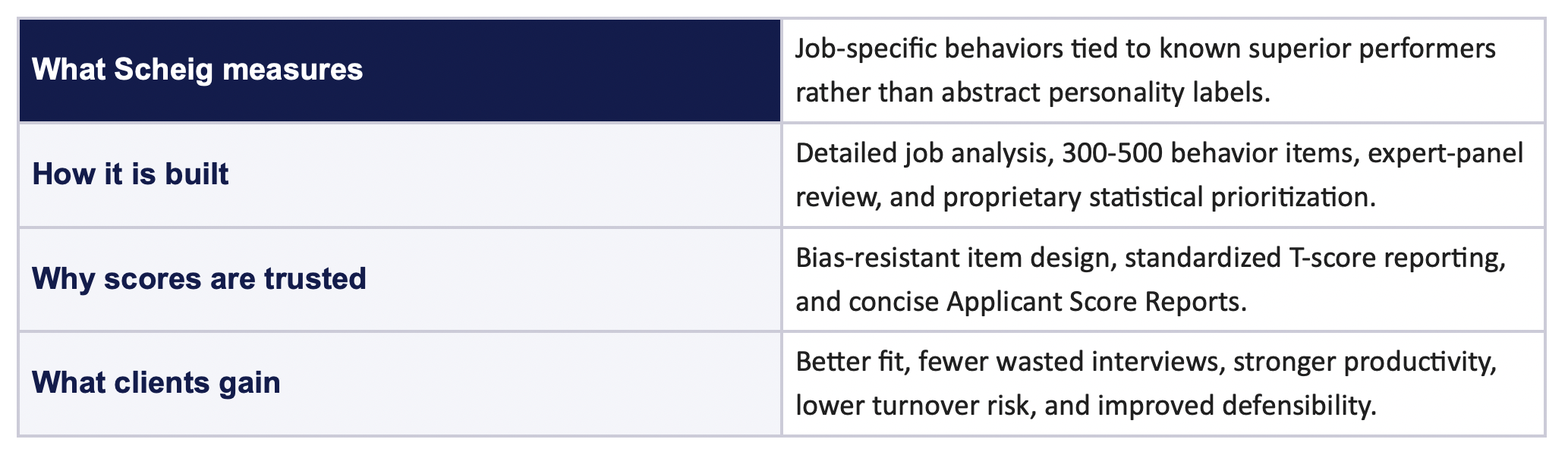
All of this leads to a simple conclusion. Scheig’s assessments are not trustworthy because they sound scientific. They are trustworthy because the science is embedded in how they are built: start with top performers, define the whole job, prioritize the behaviors that matter most, design items that reduce distortion, score candidates on a standardized scale, and apply the results consistently in hiring and development. For clients who have been with Scheig for many years, that is the real refresher. The methodology has always been about turning hidden performance drivers into observable, measurable, and actionable insights. In a market filled with broad personality tools, subjective interviews, and pressure to hire fast, that discipline still matters. It is what makes Scheig’s approach accurate, reliable, and worth continuing to trust.
There is one more reason this resonates with established clients: the methodology is delivered as part of a partnership model, not as a standalone test. Scheig Solutions is well known as professional, reliable, trustworthy, and results-oriented, with dedicated support, a client portal for rapid access to Applicant Score Reports, and tools that extend beyond hiring into structured interviews, training, and performance development. That continuity matters. A reliable assessment should not live in isolation from the rest of the talent system. Scheig’s approach connects pre-employment assessment to interview structure, onboarding insight, training priorities, and longer-term performance management. For a client who has relied on the system for years, that means the assessment is still doing what it was designed to do from the beginning: helping your organization hire with more confidence, move faster with less guesswork, reduce avoidable risk, and build a stronger workforce around the real behaviors that drive success.