
As organizations grow, hiring becomes more complex.
Multiple managers may be involved. Different locations may have distinct applicant pools. Departments may face varying staffing pressures. Over time, each hiring manager may develop their own habits, preferences, and assumptions about what makes a “good candidate.”
That is where inconsistency begins.
One manager may place the most weight on the interview. Another may focus on prior experience. Another may prefer candidates who seem confident, personable, or similar to past successful employees. While these impressions may feel useful in the moment, they can create a hiring process that varies widely across individuals and locations.
Reliable hiring requires something stronger.
It requires a clear, objective, job-specific standard that every hiring manager can apply the same way, every time.
At Scheig Solutions, we believe reliable hiring begins with understanding what success truly looks like in the job. Not in theory. Not in a generic competency model. Not in a personality profile. Real success is found in the behaviors demonstrated by superior performers already doing the work.
That is the foundation of the Scheig Solutions methodology: to hire more people like your best employees, you must first understand what they do.
This matters especially for organizations with multiple managers or locations. Without a consistent framework, hiring decisions can depend on who is doing the hiring rather than on what the job truly requires. That creates risk. It may lead to uneven performance, higher turnover, a greater training burden, and frustration among supervisors who feel they are constantly rehiring for the same role.
A reliable hiring process starts with behavioral job analysis.
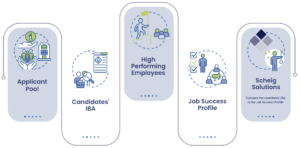
Scheig Solutions identifies the specific behaviors that high performers demonstrate in a given position. These behaviors may include reliability, judgment, attention to detail, communication, safety awareness, willingness, follow-through, teamwork, and the ability to perform under pressure. Together, they form the Job Success Profile™, a job-specific blueprint for what high performance looks like.
From there, SelectRight™ assessments measure how closely each applicant aligns with that blueprint. This is not a personality test, an IQ test, or a broad aptitude measure. It is a behaviorally based assessment built around the actual requirements of the job.
The result is a standardized T-Score.
The T-Score provides hiring managers with a clear, consistent way to compare applicants on the same scale. A T=50 score represents the recommended standard for behavioral job fit, while higher scores indicate stronger alignment with the behaviors demonstrated by superior performers. This helps managers quickly identify which applicants are more likely to succeed and which may pose greater risk.
For multi-location organizations, this consistency is especially valuable.
A candidate applying to one branch, region, or department should be evaluated using the same behavioral standard as a candidate applying elsewhere for the same role. This reduces variability, strengthens fairness, and helps leadership maintain better control over workforce quality across the organization.
The Applicant Score Report further supports reliable hiring by presenting the applicant’s T-Score, experience, and willingness responses in a clear, practical format. Hiring managers can use the report to identify strengths, potential concerns, and areas to explore during the structured interview.
This is where the system becomes both efficient and human.
Reliable hiring does not mean removing judgment from the process. It means equipping hiring managers with better information before they exercise that judgment. The structured interview helps managers confirm behavioral fit through consistent, job-specific questions. Each applicant is evaluated using the same process, reducing the influence of bias, first impressions, or inconsistent questioning.
This also improves legal defensibility. When hiring decisions are based on job-related behaviors, standardized scoring, consistent cut scores, and documented interview practices, organizations are better positioned to demonstrate that selection decisions are fair, objective, and aligned with job requirements.
Reliable hiring also saves time.
When assessments are used early in the hiring process, managers spend less time interviewing applicants unlikely to be strong behavioral fits. Instead, they can focus their time, energy, and attention on pre-qualified candidates who have already demonstrated stronger alignment with the job’s success profile. This improves the interview-to-hire ratio and helps reduce the cost and frustration of prolonged hiring cycles.
In tight labor markets, consistency is even more important. When applicant volume is low, organizations may feel pressure to lower standards. But the long-term cost of hiring the wrong behavioral fit can be significant: turnover, performance issues, safety concerns, customer dissatisfaction, and additional supervisory burden.
A vacancy is costly. A poor fit can be even more costly.
Reliable hiring across multiple managers and locations requires a system that is simple, clear, accurate, and repeatable. It requires a common language for evaluating candidates and decision-making tools that help managers focus on what matters most: the behaviors that drive performance.
That is the power of a behaviorally based hiring system.
When every manager uses the same job-specific standard, organizations make more consistent decisions, build stronger teams, reduce turnover, and create a more stable workforce. Reliable hiring is not just about choosing better applicants. It is about building a stronger organization, one consistent decision at a time.
FAQs
1. What does reliable hiring mean for organizations with multiple managers or locations?
Reliable hiring means every hiring manager uses the same clear, job-specific standard to evaluate applicants. In organizations with multiple managers, branches, departments, or locations, hiring can become inconsistent when each manager relies on personal preferences, first impressions, or different ideas of what makes a strong candidate. A reliable hiring process creates consistency by focusing on the behaviors required for success in the role.
2. Why is consistency important in the hiring process?
Consistency is important because inconsistent hiring decisions can lead to uneven performance, higher turnover, greater training demands, and frustration among supervisors. When applicants are evaluated using the same behavioral standard across locations or departments, organizations can make fairer, more objective decisions and improve workforce quality over time.
3. How does behavioral job analysis improve hiring decisions?
Behavioral job analysis identifies the specific behaviors demonstrated by high-performing employees in a particular role. These behaviors may include reliability, judgment, communication, attention to detail, teamwork, safety awareness, follow-through, and the ability to perform under pressure. By understanding what successful employees actually do on the job, organizations can build a more accurate hiring standard for future applicants.
4. What is a Job Success Profile™?
A Job Success Profile™ is a job-specific blueprint that defines what high performance looks like in a role. It is built from the behaviors demonstrated by superior performers already doing the work. This profile helps hiring managers evaluate applicants based on the job’s actual requirements rather than generic traits, assumptions, or broad personality categories.
5. How do SelectRight™ assessments support reliable hiring?
SelectRight™ assessments measure how closely an applicant aligns with the Job Success Profile™ for a specific role. The assessment produces a standardized T-Score, giving hiring managers a consistent way to compare candidates on the same scale. This helps organizations identify applicants more likely to succeed, reduce variability among hiring managers, improve interview efficiency, and support fair, job-related hiring decisions.