
Standardized scores reveal genuine differences and accelerate fairer, more consistent hiring.
Good hiring depends on clear signals. When organizations measure the behaviors that actually produce results, they can replace guesswork with repeatable decisions. That’s the power of T-scores when they’re applied to job-specific assessments: a single, standardized scale that converts a candidate’s pattern of responses into an interpretable statement of behavioral alignment with top performers. The result is clarity for hiring managers, speed for recruiters, and defensibility for HR and legal teams.
One scale, one language
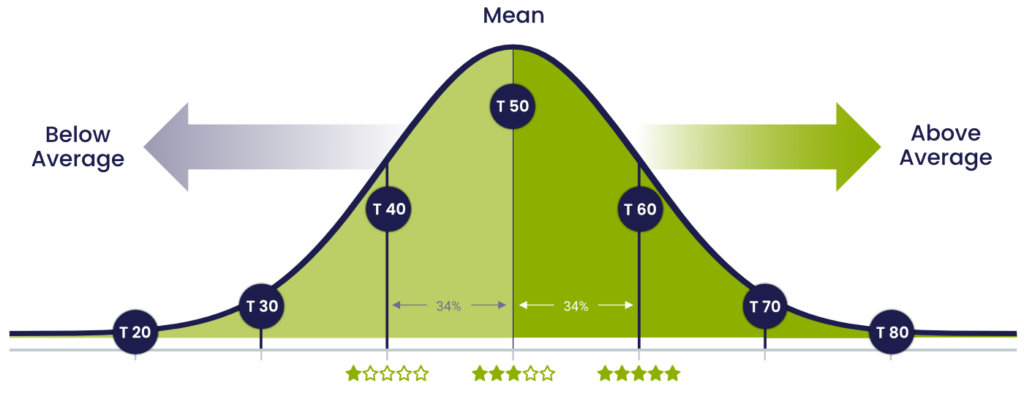
A T-score places every candidate on a shared metric: by convention, the scale is centered on a mean of 50 with a standard deviation of 10. That math gives hiring teams an immediate, intuitive vocabulary—average, one standard deviation above or below average, and so on—without requiring specialist training. Because the scale is consistent across forms, subscales, and administrations, a T-score becomes a common language that everyone in the hiring process can use to interpret where a person stands relative to the tested population and the behaviors your organization cares about. This standardization is not academic hair-splitting; it is the operational foundation for fair, repeatable decisions.
Built from the job up
A T-score is only as meaningful as the instrument behind it. Scheig’s SelectRight™ methodology begins with a detailed Job Success Profile™ — an inventory of observable behaviors produced by subject-matter experts and organized to reflect what superior performers actually do on the job. Items are selected and prioritized based on their relevance to performance; the aggregated, normalized result is a T-score that summarizes *behavioral alignment* rather than trivia. In other words, the number represents proximity to the actions that create outcomes, and the Applicant Score Report (ASR) packages that insight for immediate hiring use.
Practical clarity for the hiring workflow
Hiring leaders value simplicity that leads to action. T-scores deliver that in three practical ways:
Interpretability at a glance. Because T-scores have a fixed mean and spread, a hiring manager can see whether a candidate is typical, below, or above the tested population without psychometric training. Reports highlight overall T-Score along with any inexperience flags or unwilling responses, so decisions are fast and grounded in observable data.
Consistent aggregation. Subscales and composite measures can be combined easily when they share a common scale. That means you can create composite profiles (for example, technical judgment plus teamwork judgment) that make sense mathematically and operationally—no ad-hoc weighting debates required.
Visibility into meaningful differences. A T distribution organizes scores into a familiar bell curve, revealing where most candidates cluster and where outliers lie. Having that structure makes it clear which differences are practically meaningful and which are not, so teams focus on real differentiation rather than noise.
Reducing bias and improving fairness
Standardized scoring helps reduce the ad-hoc judgments that often introduce bias. When assessments map directly to SME-anchored job behaviors and outputs, and when scores are reported on a consistent scale, it becomes easier to enforce objective decision rules across teams and geographies. That consistency reduces the subjective variability that can give rise to unequal treatment and makes hiring decisions easier to justify. Scheig’s design—anchored items, behaviorally descriptive scoring, and standardized T-score normalization—puts fairness into everyday practice.
Defensibility that matters to legal and compliance teams
A T-score is more than a tidy number: it’s part of an auditable selection narrative. Regulators and auditors look for content validity, documented job analysis, psychometric controls, and transparent reporting. Scheig’s process — from SME inventories to pilot testing and standardized reporting — produces the artifacts that support EEOC/OFCCP defensibility. A clear T-score in an Applicant Score Report lets HR tell a repeatable story: here is the Job Success Profile, here is how the candidate aligns to it, and here is why that person was advanced. That clarity is the backbone of defensible hiring.
Speed and scalability for modern talent programs
T-scores make it practical to scale assessments across large hiring populations and multiple locations. Because the metric is standardized, organizations can apply the same decision cutoffs and prioritization rules everywhere, shortening time-to-hire and easing adoption. Operational rules are simple—aim for applicants at or above the population mean and give special attention to candidates a half to a full standard deviation above that mean, who consistently resemble superior performers. Packaged into the ASR with clear flags and no psych jargon, the T-score becomes an instant tool for recruiters and managers.
From insight to impact
Measurements only matter if they change what organizations do. A T-score aligned to job behaviors does exactly that: it helps teams prioritize finalists, shape structured interviews that probe the same behaviors, and design onboarding and development plans tied to observed gaps. Because the same behavioral standard underlies hiring and development, organizations see faster time-to-productivity and more predictable outcomes.
Bottom line: a T-score is a practical, standardized expression of how closely a candidate matches the behaviors that lead to success. For hiring teams that need clarity, fairness, and speed—without psychometric complexity, T-scores provide a single, defensible metric that enables better decisions.
FAQs
What exactly is a T-score, and why does it matter for hiring?
T-score is a standardized score with a mean of 50 and a standard deviation of 10. It places every candidate on a single shared metric, so differences are interpretable (for example, T=60 is 1 SD above the mean). That single scale gives hiring teams immediate intuition about where a candidate sits relative to the tested population and the behaviors your organization values.
How should hiring teams interpret common T-score ranges?
Use simple rules of thumb: T=50 is the tested population average; candidates in the T=56–65 range are roughly a half to a full standard deviation above that mean and therefore show stronger behavioral alignment to top performers. These bands help teams prioritize finalists and focus interviews on the most promising hires.
How does a T-score relate to the Job Success Profile™ and real job behaviors?
Scheig’s assessments begin with SME-driven job analysis that yields a Job Success Profile™—the observable behaviors of superior performers. The T-score summarizes how closely a candidate’s response pattern matches that profile, so the number represents behavioral alignment, not trivia or disconnected test items. The Applicant Score Report pairs that score with experience and willingness flags for actionable insight.
Will using T-scores help with fairness and legal defensibility?
Yes. Standardized scoring tied to SME-anchored job content, pilot validation, and clear reporting creates the content validity and documentation that auditors and regulators expect. A consistent T-score metric reduces ad hoc judgment, supports objective decision-making across sites, and produces an auditable narrative for compliance.
How do T-scores change everyday hiring operations?
T-scores simplify interpretation (no psych jargon required), enable consistent aggregation across subscales and forms, and speed decision-making with clear Applicant Score Reports (overall T-Score, experience indicators, unwillingness flags). That operational clarity shortens time-to-hire, scales across locations, and reduces reliance on expert interpretation.