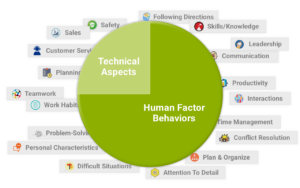

Personality = abstract. Behavior = predictive. Here’s a simple rule: if it won’t change the outcome on the job, it shouldn’t change your hiring decision.
Hiring teams love tidy labels. Personality tests give them neat categories — “extrovert,” “conscientious,” “high openness” — and a comforting shorthand to summarize candidates at scale. But that shorthand hides a big problem: personality tests tell you who someone is in the abstract, not what they do on the job. And when hiring is a bet on future performance, the difference between is and does matters more than you think.
The Distinction That Changes Hiring Outcomes
Personality instruments measure global tendencies. They’re useful in research, coaching, and sometimes in culture-fit conversations. But hiring is a practical decision: will this person reliably execute the tasks, repeat the behaviors, and make the same choices that your best performers make day after day?
That’s where job-specific behavior measurement wins. Instead of inferring the job from a trait, it starts with the job, carefully analyzing what top performers actually do, and builds the assessment around those behaviors. This is not subtle semantics. It’s the difference between guessing at what will matter and measuring what already matters.
Consider three common hiring errors when organizations rely on personality-first approaches:
- The inference gap. Suppose a candidate scores “high conscientiousness.” That doesn’t directly tell you whether they will complete required safety checks before nap, consistently wash hands between activities, or correctly administer medication according to a plan. Translating “conscientious” into those behaviors requires a leap — and different people express conscientiousness in different ways.
- Performance convergence. High performers often look different in personality but identical in behavior. A high-performing introvert and a high-performing extrovert can both be superb at customer de-escalation because they share the same job behaviors (calm problem-solving, escalation discipline, and documentation), not because they share a trait.
- Selection leakage. Traits may correlate with outcomes in complex, pooled datasets, but correlations aren’t always causal. If you select on traits, you risk screening people on signals that don’t drive on-the-job success, and you make hiring decisions harder to justify to stakeholders and auditors.
When the stakes are children’s safety and developmental progress, you want an assessment that maps to observable, trainable, and repeatable on-the-job behaviors.
If predictability is the goal, behavior is the better unit of measurement.
What “Measure the Job” Means for a Childcare Provider
A job-first approach begins with the actual tasks, decisions, and interactions that separate top performers from average ones. For a childcare provider, a Job Success Profile™ will often include behaviors such as:
- Continuous environmental and child supervision — making visual scans, anticipating hazards.
- Consistent implementation of routines (mealtimes, naps, transitions) to reduce behavioral escalation.
- Accurate documentation of incidents, injuries, and medication logs.
- Calm and effective de-escalation of tantrums and conflict among children.
- Clear, regular communication with parents about progress, incidents, and schedule changes.
- Adherence to health and safety protocols (handwashing, sanitization, proper food handling).
- Coaching and positive behavior supports to encourage developmentally appropriate behavior.
The assessment’s job: measure whether candidates already behave like your best providers on those specific items.
How SelectRight Turns Theory into Practice
SelectRight™ does not begin with a trait map and then make a “logical leap” to apply it. Instead, it starts with a thorough job analysis of top performers and builds the assessment from scratch, ensuring each item reflects real job behaviors. The approach usually includes an Interest & Willingness checklist (serving as a job preview and experience/unwillingness diagnostic), Self-Rating forced-choice pairs that account for social desirability and reveal true behavioral tendencies, and — when suitable — Critical Incidents that present realistic on-the-job scenarios to observe how an applicant might respond. This design generates a T-score that compares each candidate to your best performers’ success profile — providing a much clearer prediction of on-the-job success than a simple trait label.
(If you ever need to explain SelectRight briefly to stakeholders: “We measure how someone will behave on the job, not how they score on a personality trait that needs interpretation.”)
A Clear Contrast: Personality Test Vs. Job-Specific Items
Personality question: “I enjoy being around people.”
Job-specific behavioral item: “When supervising outdoor play, how often do you perform a visual sweep of the entire area every 60 seconds and position yourself to see all children?” (paired with a low-performance alternative)
The personality question indicates a general preference; the behavioral item assesses a safety-critical habit. A childcare provider who ‘enjoys people’ might still be inattentive to supervision; the provider who reports and demonstrates frequent, systematic scans is directly showing a behavior that prevents accidents.
Another example: instead of asking whether someone is “calm under pressure” (a trait), a job-focused assessment might present a critical incident: a toddler has a sudden, high fever seizure. The multiple-choice scenario offers realistic responses, and the correct answer reflects the actions of top performers (clear the airway, call emergency services, follow the center’s incident protocol, notify the director/parent). That’s a direct test of competence under stress — and it is far more predictive of safe outcomes than a trait score.
Operational Advantages for Childcare Centers
When childcare operators switch to job-based assessments, they experience immediate operational gains.:
- Better early screening. Application screenings reduce the number of interviews for candidates who lack core safety and supervision skills.
- Practical onboarding. Interest and Willingness identify training needs (e.g., medication administration, nap supervision), so managers can assign targeted 30-day learning modules rather than generic orientation.
- Quicker onboarding. Hiring individuals who align with behavioral anchors shortens the time to full productivity with children.
- Improved defensibility. Documenting job analysis, behavioral anchors, and consistent cut points makes it easier to defend selection decisions in regulatory or legal reviews.
The One-Line Test for Any Assessment You Consider
Before purchasing or adopting an assessment, ask yourself: does it evaluate how a candidate will behave in this role — based on how our top performers act — or does it merely assess who the candidate is in the abstract? If the tool measures traits without a clear, documented connection to job behaviors, proceed with caution. However, if it is developed from a thorough job analysis, with benchmarks from top performers and behaviorally realistic items, then you are on the right path.
Final Thoughts and Practical Test
Personality labels are convenient. But in childcare, convenience can’t outweigh predictability. Flip the personality tests upside down, stop measuring the trait, and start measuring the job. That shift doesn’t just improve hiring accuracy; it gives managers usable data for interviewing, onboarding, and growing talent.
Use this simple test for any assessment: Does it measure how the candidate will behave in the specific tasks that keep children safe and thriving? If it doesn’t, it’s not the right tool for a childcare provider role.