A license, certification, or credential clearly shows that this person has passed a standardized test or completed required training. A résumé, on the other hand, indicates where someone has worked and what they have been exposed to. However, neither reliably answers the most important question for any hiring manager: will this person consistently perform the daily tasks that keep the job running smoothly?
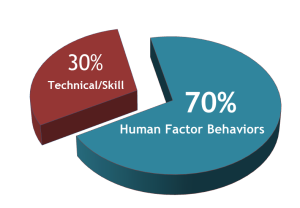
Scheig’s research and assessment work makes a simple, powerful point: technical competence — the “can they?” — is essential but often only a small part of the performance picture. The larger, more important factor is the human behaviors people use daily: follow-through, judgment, attention to detail, safety focus, learning agility, and routine reliability. In short, two licensed professionals can perform very differently because the difference lies in behavior, not certification.
Why Credentials Are Necessary but Not Enough
Licenses and certifications are binary signals: the candidate either passed or didn’t. They indicate whether someone met a basic level of knowledge or standards at a specific time. Resumes expand on that signal by showing exposure — roles held, years of experience, places worked — which are helpful for screening. However, both signals reduce the complexity of daily work into simple lines on a page.
Consider the examples that clearly illustrate this: a skilled teacher and a poor one can both be fully licensed; an excellent attorney and a mediocre one can both have passed the bar; an electrician who installs reliably and one who cuts corners can both hold the same certificate. The common point is that certification verifies capacity, not habit. What truly influences real-world results are the consistent human behaviors that turn capacity into reliable outcomes.
What Behaviors Truly Distinguish Performance?
Across various jobs and industries, Scheig’s job analyses repeatedly reveal the same pattern: technical skill is essential, but predictable success depends on a set of observable, job-specific behaviors. These typically include:
- Reliability and consistency. Showing up, following procedures, and delivering steady results day after day.
- • Attention to detail. Detecting small errors before they turn into major problems.
- • Learning agility. Using feedback, adapting to changing conditions, and continuously improving.
- • Judgment and escalation. Knowing when to act, when to ask for help, and when to escalate — especially important in safety-sensitive roles.
- • Collaborative execution. Communicating clearly, working well with teammates, and sharing responsibility for results.
- • Task persistence. Being willing to do the unglamorous, repetitive work that keeps systems running.
These are not abstract personality traits. They are observable, definable, and measurable behaviors — and they explain why two equally credentialed people can perform very differently once the situation arises. Scheig’s methodology starts with a thorough job analysis to identify these behaviors, creating a Job Success Profile™ that acts as the standard for selection.
Why Interviews and Résumés Are Not the Best Tiebreakers
Resumes confirm exposure: they show that a candidate has relevant experience and proper paperwork. Interviews reveal storytelling, presence, and preparation. Both are useful, but can be noisy when predicting actual job performance. People rehearse answers; social comfort and communication skills can hide true ability; brief conversations are poor substitutes for observing consistent behavior under real conditions. Scheig has documented that relying only on interviews or resumes often leaves hiring to luck in the middle — exactly where most hiring decisions end up when candidates have similar credentials.
How to Make Behavior the Decisive Signal
If behavior is the differentiating variable, then selection should be built to reveal behavior. Scheig’s research translates into practical steps you can apply immediately:
- Define the job by behavior. Start with a focused job analysis and list the behaviors that predict success in the first 90 days and at six months. These become your selection criteria — not vague traits, but actionable actions.
- Structure interviews around behavior. Ask the same, job-specific behavioral questions of every finalist and use anchored scoring. This turns interviews from impression-gathering into standardized evidence collection.
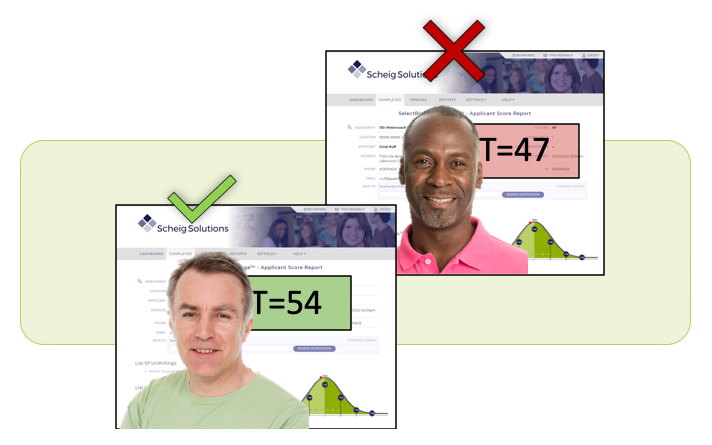
- Use a consistent scoring system. Combine résumé signals, assessment evaluation scoring, and structured interview scores. Scheig’s T-Score and Applicant Score Report standardizes comparison across candidates, making behavioral match visible and defensible.
- Track outcomes and refine. Measure hire performance, then close the loop: use actual on-the-job data to refine which behaviors most strongly predict success for that role.
These steps don’t eliminate human judgment; they focus it. They move hiring from “Who told the best story?” to “Who routinely does the things this job requires?”
The Payoff: Predictability, Not Luck
Scheig’s work shows that when organizations prioritize job-specific behaviors — and use assessments and structured measures aligned to those behaviors — predictability improves dramatically. Behavior-based selection reduces turnover, shortens time-to-productivity and protects safety and service quality. In short, it turns hiring from a gamble into an investment. Scheig’s behaviorally based assessments reliably raise predictability to between 88-92% — a dramatically different outcome than relying on credentials or interviews alone.
A Final, Practical Thought
When you’re choosing between two candidates who both hold the right license or certificate, ask a different set of questions. Don’t ask whether they’ve had the exposure; ask whether they’ve demonstrated the behavior. Which candidate persistently does the routine work that keeps systems humming? Who learns from small mistakes and corrects course? Whose track record shows the quiet habits that protect quality, safety, and productivity?
A license proves someone can do the work. Behavior proves they will do it — day in, day out. Make behavior your deciding factor, and you stop hiring for credentials and start hiring for outcomes.