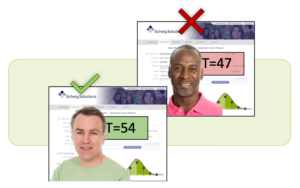

Scheig’s research is clear: when hiring teams mainly rely on interviews to predict job success, their chances are about 50/50 — like flipping a coin. Sometimes, the odds are even worse. This pattern is most noticeable when choosing between two candidates who both seem qualified on paper: licensed, certified, with similar resumes, and meeting the checklist requirements, but they will act very differently once on the job. The main difference is always behavior.
Below, I’ll unpack what that 50/50 reality really means, why interviews fail in this middle zone, and how a behavior-first approach, the core of Scheig’s method, materially improves those odds.
What “50/50” really says about interviews
Referring to interviews as a 50/50 predictor is more of an empirical observation than an insult: interviews effectively distinguish clear mismatches from the rest but poorly differentiate among candidates who are roughly acceptable. In many hiring situations, an interview reliably filters out individuals who clearly cannot perform the job. Its failure occurs in the middle range, the pool of candidates who are credentialed, articulate, and “good enough.” In that area, small impressions, charisma, and rehearsal become decisive, yet these qualities don’t consistently correlate with on-the-job performance. Scheig describes this as a measurement problem: interviews assess stories and presence, not the repeatable behaviors that lead to consistent performance.
Why interviews are brittle, especially between two “acceptable” finalists
Several factors weaken the predictive power of interviews when candidates are equally matched on credentials.
- Interviews reward presentation, not repetition. A practiced answer or a compelling anecdote shows communication skill, and that matters, but it’s not the same as consistently performing the daily behaviors that the job requires. A candidate who can tell a convincing story may still struggle with the quiet, repeatable work that makes progress.
- Human judgment is inconsistent. Different interviewers have varying expectations and unconscious biases. Small differences in rapport, tone, or phrasing can influence decisions even when those factors aren’t related to job performance. The result: two interviewers can reasonably form opposite impressions of the same person.
- “Credential parity” conceals differences in behavior. Licenses, certifications, and titles can level the playing field on resumes. But having the same credentials does not often mean the same behavior. Two people with identical certifications might approach work differently in terms of attention to detail, follow-through, or learning flexibility, and these behavioral differences only become clear after hiring.
- Interview environments are artificial. They simplify complex hiring decisions into a brief, socially charged meeting. They often favor quick responses and social skills, things that can be coached, while undervaluing less glamorous qualities like persistence, consistency, and attention to detail.
Taken together, these factors explain why, when the slate narrows to “two acceptable” candidates, interviews tend to leave the decision to chance rather than predict who will actually perform.
Behavior reflects the predictive difference.
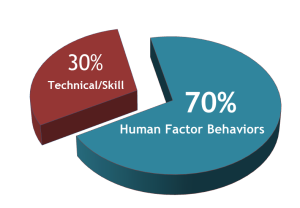
Scheig’s research redefines hiring by highlighting an important insight: technical skills are necessary but often represent only a small part of overall performance. The “70/30” idea — approximately 30% technical competence and 70% behavior — explains why credentials alone do not guarantee success. High-performing individuals don’t just possess the right knowledge; they consistently do the small, repeatable actions that make teams effective: arriving on time, following procedures, escalating issues appropriately, learning quickly, maintaining quality, and collaborating smoothly. These are behaviors, and behaviors are measurable.
When two candidates have the same certifications and similar technical skills, behavior becomes the deciding factor. One candidate’s license or certificate shows they passed a standard; the other candidate’s daily behavior reveals whether they will turn that standard into consistent results.
How Scheig’s approach improves the odds
Scheig shifts the question from “How well did someone interview?” to “How well does this person match the job’s success behavioral profile?” This change is practical and measurable.
- Job analysis first. Scheig starts with a thorough job analysis to identify the behaviors that actually predict success in the role. Those behaviors become the Job Success Profile™ — the baseline for everything that follows.
- Focus on evaluating behaviors rather than personalities. Assessments and structured interviews are intended to measure specific behaviors identified in the job analysis. This transformation makes interviews effective diagnostic tools.
- Use direct demonstrations. Short simulations, work samples, or critical-incident responses show how candidates behave in role-like situations. Those demonstrations consistently outperform interview impressions because they reveal actual behavior under stress or constraint.
- Standardize scoring. Scores like Scheig’s T-Score provide a consistent scale, so hiring decisions rely on comparable evidence rather than impressions. Scheig’s assessments and Applicant Score Reports make behavioral matches clear and actionable.
This isn’t just theory. Scheig reports assessment accuracy in the high 80s to low 90s when hiring relies on behavior-based methods — a much better chance than a coin toss. Scheig’s assessments are designed to increase predictability, reduce bias, and improve hiring outcomes.
What hiring teams should do differently tomorrow
If interviews feel like a coin toss, start with behavior:
- Identify job behaviors that make someone successful in the role. Not traits or buzzwords — observable actions.
- Make interviews behavior-focused and scored. Ask the same, job-specific questions, and rate answers against anchors.
- Use assessments to standardize comparison. Give weight to direct demonstrations of behavior over charm or polish.
- Close the loop. Track hire outcomes and refine the behaviors you measure over time.
The bottom line
When candidates clearly differ, interviews can be decisive. When candidates are both “acceptable,” interviews often become inconclusive — and that’s where behavior counts most. Scheig’s research doesn’t dismiss interviews; it redefines them as one tool among others in a toolbox that must align with the job’s behaviors. Doing this transforms hiring from a 50/50 gamble into a repeatable process that yields consistent, measurable results. View interviews as evidence-gathering rather than final judgments — and let behavior be the measure of difference.
For more information, contact Chris Fisher at (800) 999-8582 or visit www.scheig.com.